


Healthy, beautiful nails are an essential part of the image of a well-groomed person.When greeting, the interlocutor pays attention to the hands when shaking and subconsciously assesses their condition.For this reason, it is recommended to use varnish against nail fungus as a preventive and therapeutic agent.
The active principle of antifungal varnishes
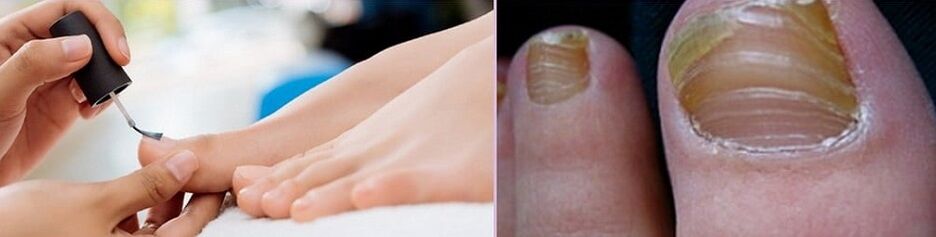
Depending on the severity of the disease and the location of the fungal infection, doctors recommend different remedies and techniques that, in individual cases, cure the fungus in the shortest possible time.At the initial stage of infection, a good reaction was noted after using a special antifungal varnish.The active ingredients of the composition penetrate deep into the nail plate and can even kill fungal spores.
When applied, the nail plate softens, improving the penetration of the treatment.After drying, the concentration of the antifungal agent in the affected tissues increases by 20% and persists for seven days.The maximum concentration of active ingredients is reached on the seventh day of applying the varnish on the hands and on the fourteenth day on the feet.
Manufacturers of antifungal varnishes produce their products under different names, but the principle of operation is identical for each of them.Therapeutic antifungal varnishes are actively used to get rid of onychomycosis and prevent relapse of the disease.Such agents are also used very effectively to prevent fungal infections.
Fungal nail polish can be either alcohol-based or oil-based.Regardless of the consistency, they are equally effective in inhibiting the spread of a fungal infection.The main thing is to find out the type of pathogen in advance in order to correctly select the active ingredient and its concentration.Only in this case the use of varnish will give the expected result.
The liquid consistency allows the active components of the varnish to penetrate into every microcrack of the surface to be treated, achieving maximum effect even on the deepest layers of the nail plate.The active components of the varnish work most effectively at the initial stage of the development of a fungal infection.They not only destroy fungal cells, but also their spores.After drying, the composition covers the nail with an imperceptible film that prevents oxygen from penetrating the remaining spores, preventing them from multiplying further.
When caring for fungal nails, it is necessary to use only individual tools that must be disinfected after each use.Otherwise, you can provoke a re-infection.
When treating nail fungus, it should be taken into account that many times more medicinal substances can accumulate in the toenails than in the fingernails.It is also undesirable to use antifungal varnishes from different manufacturers at the same time, as this leads to a reduction in the antifungal effect and a delay in the treatment process.
Advantages and disadvantages
Let's consider all the positive and negative aspects of using nail polish for nail fungus.The treatment process itself requires preliminary preparation of the nails.Note that the fungus is most often diagnosed on the feet.This is because when wearing dirty, poor quality or uncomfortable shoes, the feet are often exposed to a humid and warm environment, which in turn favors the development of fungi.
The main disadvantages of antifungal varnishes include the high price and the lengthy preparation of the feet before using the product.Inexpensive drugs of this type may indicate a fake, so you should not buy them.
During the treatment, foot care measures (pedicures, varnish, use of lotions and creams) must be completely avoided.These measures can lead to increased growth of the fungus and aggravation of the inflammatory process.
The positive aspects include the effectiveness of the product at the initial stage of development of fungal diseases and ease of use.An important advantage of this form of antifungal is not only the ease of use, but also the formation of a permanent film that “fixes” the active ingredient in the affected area and prevents it from washing off.
We can also add a whole list of positive aspects of use:
- can be quickly attached to the nail;
- local effect without additional medications;
- minimal toxicity;
- is on free sale;
- easy to use;
- has a preventative effect;
- proceeds sparingly.
How to apply medical varnishes correctly
Before using nail polish for toenail fungus, you need to prepare the infected surface.To do this, you need to wash your feet, preferably with laundry soap, and dry the skin with a natural cloth.If necessary, you can steam your nails in water with the addition of celandine or propolis tincture (for additional disinfection).
Next, you need to disinfect the surface of the nails and, using a special file that comes with the varnish, clean the affected surface of the nail and shorten its length.Only then can the paint be applied.
For those who are afraid to clean the nail plate themselves or do not want to remove it, there is an easier way to prepare the nail - a hygienic bath with soap and soda solution.
Once the preparation of the infected nail is complete, an antifungal medication is applied.Experts recommend carrying out the procedures at least once every 7 days.Before reapplying the varnish, the previous treatment layer must be removed using a commercially available solvent.Processing is carried out strictly according to the instructions included in the kit, since each drug has its own nuances when used.
Which nail polish is best suited for nail fungus – an overview of effective remedies
Very often, patients ask the doctor which varnish is most effective against fungi.Due to the individual characteristics of each person's body, the degree of infection and the type of fungus that causes it, it is impossible to recommend the best varnish for toenail fungus.Therefore, the same drug can manifest itself in completely different ways in different cases.Below we present a list of the most effective medications for nail fungus, but they should still be selected individually.
Based on amorolfine
This is one of the most inexpensive drugs in the line of antifungal varnishes.The therapeutic effect of varnishes only becomes apparent in the initial stage of fungal development, when the nail has not lost its normal structure and the nail plate is not affected by more than a third.Otherwise, its use is useless.During application, a slight burning sensation may occur in the treated areas.

Based on ciclopirox
The main active ingredient, ciclopirox, has a broad spectrum of action and destroys cells of various types of fungal pathogens.It can be used to treat mold, yeast, dermatomycetes and other types of fungi as well as parasitic bacteria.
The composition quickly penetrates into the deepest layers of the nail plate and nail bed and begins to actively destroy the fungus already a day after the first application.
The application pattern is slightly different from other varnishes.In the first month, the drug is used every two days.In the second month of treatment - twice a week.For the third month of treatment, one treatment per week is sufficient.
Before applying the varnish, you must thoroughly clean the affected nail surface and shorten the length as much as possible with scissors.During the next application, the previous layer of paint is removed by scraping.The duration of treatment should not exceed six months.It is better to buy nail polish against nail fungus at the pharmacy.Do not trust dubious stalls and shops.In order not to buy a fake, buy all medicines only in trusted places.
Side effects and contraindications
Even the best varnish for nail fungus on toes and hands has contraindications to use and side effects, so you should carefully study this paragraph of the article.Antifungal varnish is a medical drug and therefore, like all drugs, has a number of contraindications and possible side effects.
Contraindications include:
- preschool age;
- pregnancy and breastfeeding process;
- individual intolerance to products that are part of the antifungal varnish;
Side effects include:
- unpleasant burning and redness at the application site (goes away on its own within a short time);
- Development of contact dermatitis.Such a reaction may occur due to inaccurate distribution of the aggressive drug and its interaction with the delicate skin of the cuticle and periungual ridges.
Reviews
After reading several reviews of people who used varnishes to treat nail fungus, we can advise you which varnish for nail fungus is better, and which one did not help them at all or caused additional inconvenience.You should not blindly believe all reviews, but you can draw some conclusions about the course of treatment.
- Woman, 32 years old: "My husband plays professional sports and has been suffering from toenail fungus for a long time and was treated with antifungal drugs, but was not completely cured. And recently I noticed that the large nails on my feet became cloudy and began to crumble badly when cut. I immediately turned to a dermatologist and heard a disappointing diagnosis - fungus. The doctor advised me to try an inexpensive varnish against nail fungus. (compared to others), which began to work very well."Just one month after the treatment, I noticed that a new, healthy, shiny nail was growing, which made me very happy!”
- Woman, 28 years old: "I often go to the swimming pool and after I injured my big toe, I noticed that it had acquired an unnatural color. After I went to the dermatologist, it turned out that, in addition to the injury, I had become infected with a fungus in the swimming pool. It's good that I recognized the problem early and the doctor said that I could get by with local treatment. The specialist advised me to buy varnish against nail fungus. The price of the drug turned out to be quitehigh, But health is even more important, so I had to buy the polish and the results were not long in coming. Now all my nails are shiny and healthy and I will protect my nails from re-fungal infection as a preventive measure.